|
somewhat increasing problem with parasite control
in various livestock, including llamas and alpacas, is the development of
drug resistance in worms. With
llamas and alpacas, this is probably even more prevalent by those farms that
must administer a monthly Ivermectin treatment as a preventative for
Meningeal Worm.
The primary prevention of parasite control always
starts with good herd management. A
good nutritional program and an awareness of the overall health of your
animals should be at the top of your list.
Parasites are more likely to seek out and attack weak or compromised
animals. A general lethargy,
weight loss, a depressed stance with a humped back, and ball or ploppy
stools, rather than pellets, are all signs of possible internal parasites.
Good sanitation, pasture rotation, and the weather also play a big
role in the control of parasites on your farm.
Increased attention to possible parasite problems is always needed in
periods of extended wet weather. Barns
and pastures should be cleaned regularly and hay and grain should always be
fed off the ground and away from manure piles.
Out in dry, sunny areas of the pasture, larvae in manure tends to dry
up. But wet shaded areas require additional attention as larvae in manure in
these areas may survive for months. Even
winter weather does not defeat some species.
Some infective larvae can even become dormant over the winter,
surviving temperatures to twenty degrees below zero, and then become
infective again about one month after pastures begin new growth in the
spring.
De-worming programs vary for different areas of the
country since various species of worms may be prevalent only in certain areas.
Again, the weather in your part of the country also plays a
big part in what you may need to treat for on your farm.
Previously it has always been recommended to treat all
the animals on your farm when de-worming.
However, parasitologists now believe that this common practice is one
of the most important factors responsible for the development of de-wormer
resistance. The animals in our
herds do not all have an even worm distribution.
Only 20-30% carry 70-80% of the worms and these animals are the ones
mainly responsible for contaminating the pastures with parasite larvae for
all the other animals. If
breeders could identify those animals and only treat the ones that actually
need de-worming, they would save money and greatly reduce the drug
resistance. This could be done
with regular fecal checks on each animal in our herd.
Regular fecal checks would allow us to identify the actual worm and
administer only the correct treatment and dosage to only those animals that
need it.
For the blood-sucking barber pole worm (Haemonchus
contortus), which has been a severe problem in various areas of our llama
and alpaca population, a new system called FAMACHA has been developed in
South Africa and has been validated in the U.S.
Since anemia is the primary effect from infection with the barber
pole worm, often resulting in death, a simple and reliable test for anemia
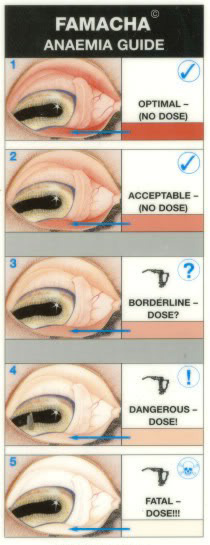
has been needed. The FAMACHA
method provides this test to identify anemic animals.
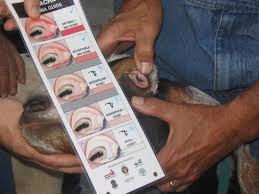
Breeders regularly check the mucous membranes around animal’s eyes
and compare the membrane color to color illustrations on a chart.
The chart portrays various levels of anemia.
Only the animals scored as anemic are then treated which results in
fewer treatments, money saved, and slowing the development of a resistance
to de-wormers. It’s reported not to be a difficult system to learn, but
one that should be taught by a certified person.
|
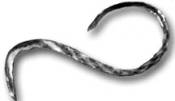
Barber Pole Worm (Haemonchus
contortus)
This blood-sucking parasite thrives in warm, wet weather.
Grazing animals ingest larvae on forages that are relatively short. Early to mid-morning forages contain the most larvae on
its moist, dew covered tips. An
adult female can consume 200 microliters of blood daily.
Outbreaks are worst when warm summer rains create a wet environment
for the hatched larvae. During
very cold conditions or drought, the majority of larvae become dormant or
die.
|
With increased reports of drug resistant
worms in all parts of the country, perhaps it would be advantageous to
re-evaluate our own de-worming program with our veterinarian.
We can certainly appreciate the information that has come from the
various farms around the country that have shared their experiences and
increased our awareness of this important concern in ruminants.
This article, written by Marilyn Nenni, appeared in the Hoosier
Hummer newsletter in 2006. |